Water · Denver
Why is water running out onto the kitchen floor?
The short answer
Water reaching the floor comes from one of four places: the drain route inside, the pan underneath, a fitting on the house plumbing, or plain condensation. Sub-Zero Appliance Repair Denver finds which before anything is opened — (303) 729-0972.
$89 service call, credited against the repair.
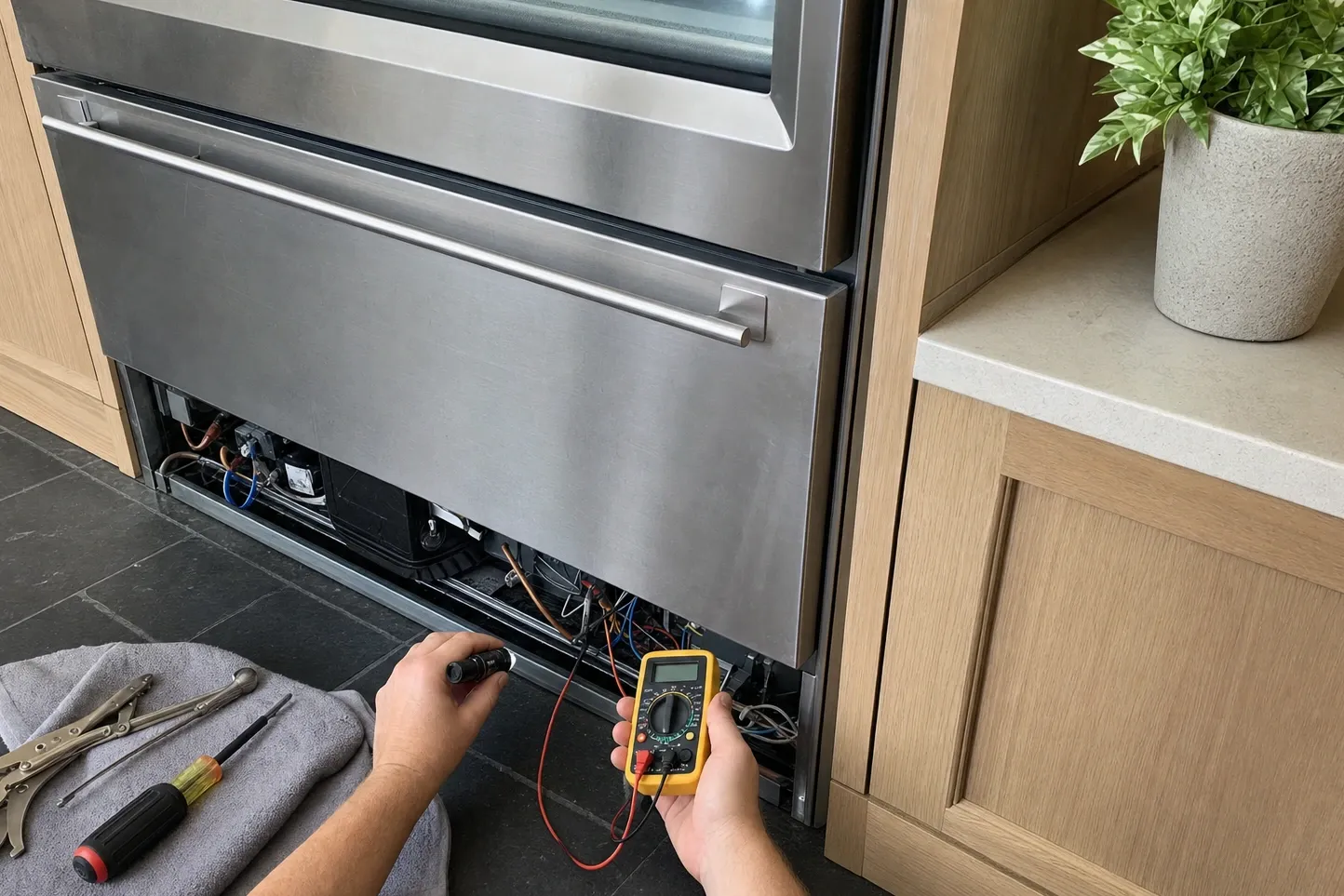
Before you call
- Put a dry paper towel down at the plinth overnight and mark where it wets first: front, left or right.
- Open the doors and run a finger along the inside floor of each compartment; water inside points at the drain, not the plumbing.
- Find the household shut-off valve feeding the cabinet — it is somewhere in the house, never on the cabinet — and close it.
- Look through the lower grille with a torch for wet metal or a bright trickle, and leave the kickplate and the pan alone.
Stop here and call Sub-Zero Appliance Repair Denver on (303) 729-0972 if water keeps arriving after you have shut the supply off.
What it usually turns out to be
-
A blocked drain route
The water is clear, it shows up in bursts rather than steadily, and the cabinet floor is wet before the tiles are.
Quoted after the diagnosis
-
A cracked or overfilled pan
Sub-Zero lists a cracked or over-full pan among the causes of water below a cabinet; the trail starts at the back and works forward.
Quoted after the diagnosis
-
A seal that stopped sealing
Room air pulled past a tired gasket condenses hour after hour, and the drain was never sized for that much water.
Door gasket or seal replacement$260–$700
-
House plumbing at the connection
The puddle is steady whatever the cabinet is doing, and it dries up the moment the supply valve is closed. A plumber owns that joint.
Quoted after the diagnosis
When it is worth a visit
Any water that returns once the supply is shut off is coming from inside, and Sub-Zero's answer page puts the clogged tube on newer built-ins in a technician's hands. Book that visit before the flooring lifts.
Reading the puddle
Water at the plinth is the end of a story that started somewhere behind the doors, and the shape of it is most of the diagnosis. Water that turns up in bursts, hours after the cabinet has been quiet, is meltwater that could not get away. A seep that runs at the same rate whatever the kitchen is doing belongs to the house supply. Damp that only appears in the busiest weeks of the year is the room condensing on something cold.
Sub-Zero’s own sequence for a leak nobody can place is to shut the supply off, take the kickplate away and watch where the water shows. That is a few minutes with a torch for someone who has done it before. What you can gather first — where the wet starts, what changes it, whether it stops — decides which way the visit goes.
Follow-up questions
Should I turn the water off before anyone comes out?
Yes, if you can find the valve and the puddle is growing. It costs nothing, it protects the joinery, and it also tells the technician something useful: a leak that stops when the supply is closed is a plumbing fault, not a refrigeration one.
Can I mop it up and wait to see if it happens again?
Water under a built-in has nowhere to evaporate to, so it goes into the subfloor and under the cabinet run instead. Sub-Zero Appliance Repair Denver would rather look at a small puddle now than at swollen joinery in a month — (303) 729-0972.
Does dry Denver air mean this cannot be condensation?
No. The air inside the cabinet is its own weather, made of what you put in and how often the door opens, and a house on evaporative cooling is damper indoors than the forecast suggests. Condensation is on Sub-Zero's own list of causes for water below a cabinet.
Talk to someone
Still doing it after the checks?
Say what changed and in what order, and the technician packs for that fault rather than for a guess. Technicians work 8:00 am to 8:00 pm, any day of the week, and the line takes a call 24/7.